Stress is not a thought you can argue with. By the time you notice it, your heart rate has already moved, your breathing has shortened, and your shoulders have come up — and none of those responded to an instruction.
That is the whole reason relaxation advice fails so often. It addresses the part of you that is listening, and the problem is in the part that isn't.
In this guide
Why "just relax" makes it worse
Three things go wrong the moment relaxation becomes a goal.
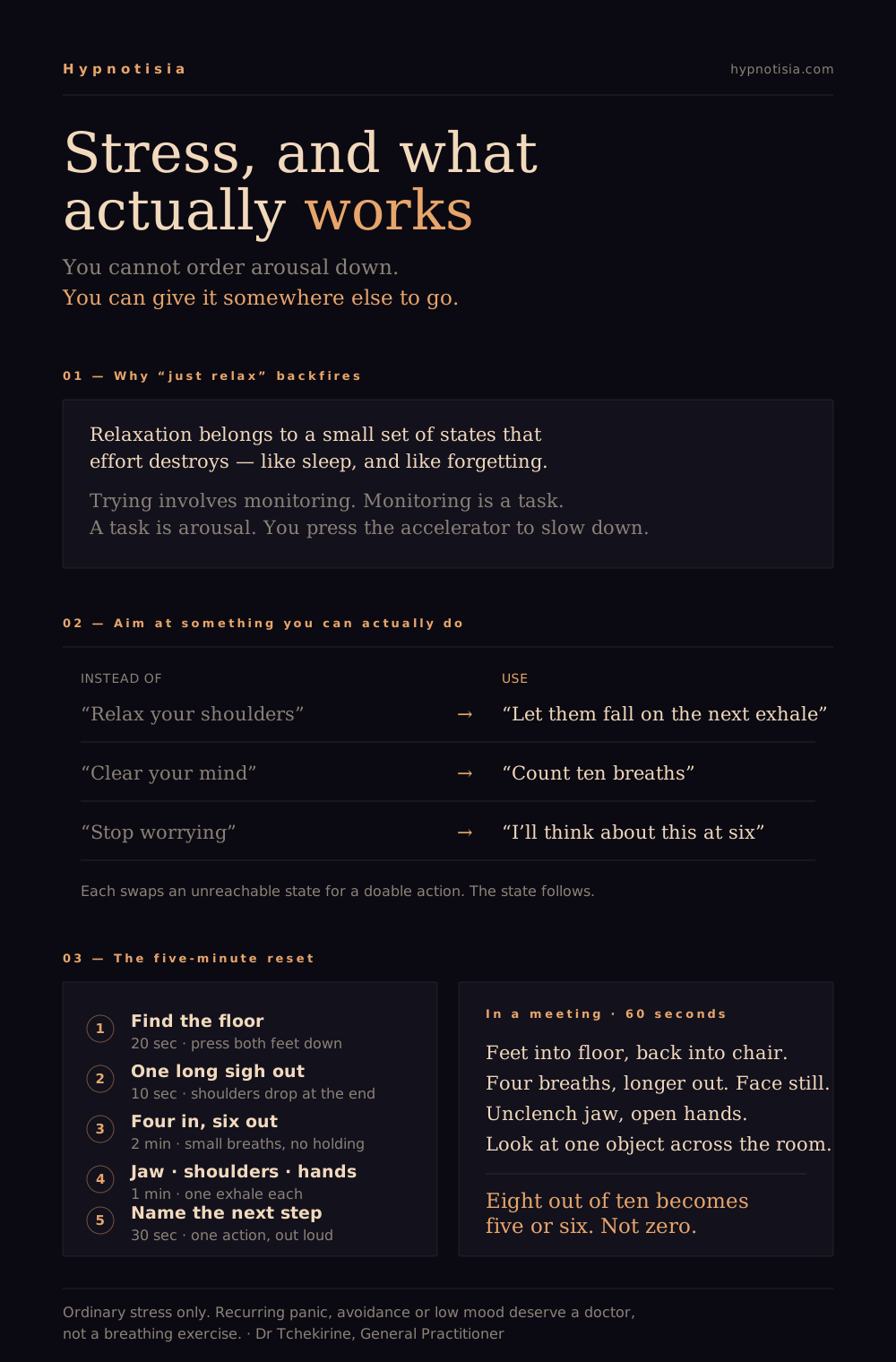
It creates a task with a standard. Now there is something to achieve, and a way to fail at it. Checking whether you have relaxed yet is itself a monitoring activity, and monitoring is arousal. This is the same mechanism that keeps people awake at 3 a.m. counting the hours left.
It requires you to hold what you're rejecting. "Stop worrying about the meeting" cannot be processed without producing the meeting and the worry. The instruction supplies the thing it is trying to remove.
It puts you at war with your own physiology. An activated body is doing something sensible — preparing for effort. Fighting it adds a second layer of tension on top of the first: now you are stressed, and also annoyed at being stressed.
You cannot order arousal down. You can give it somewhere else to go.
What self-hypnosis actually changes
Stripped of the theatre, self-hypnosis for stress does three concrete things — none of them mystical.
It uses the one autonomic control you have. You cannot slow your heart by decision, but you can lengthen an out-breath, and the heart follows the breath. A breath whose exit is longer than its entry spends more of each cycle on the calming side. That is physiology, not belief, and you can feel it inside two minutes.
It gives attention somewhere to be. Anxious attention with nothing to hold generates its own material. Weight, warmth, a count, the pressure of your feet on the floor — deliberately boring objects that occupy the stage the worry wants.
It builds a shortcut you can fire later. Practised repeatedly, a physical cue — a particular breath, a hand position, a word — starts to bring back the state that accompanied it. That is the practical value of anchoring: it makes the calm portable, so you are not dependent on lying down in a quiet room.
Direct or indirect: which one suits you
Two people can need opposite wording for the same result, and this matters more for stress than for anything else.
The direct approach instructs: your shoulders are dropping, your breathing is slowing, you are becoming calm. Efficient, and it works well for people who like a clear sequence.
The indirect, Ericksonian approach offers instead: you may notice one shoulder is already lower than the other, and there is no need to decide which. It suits people whose first reaction to "you are becoming calm" is to check — and to find that they aren't, which turns the technique into evidence of failure.
If direct suggestion has always felt like being told a comfortable lie, that is information about you, not a deficiency. Use the permissive version, and it stops being a test you can fail.
Where to start
Four articles in this guide, listed at the top of the page. If something has just happened, start with the five-minute reset. If relaxation techniques have never worked for you, start with why that happens.
The honest limit
Self-hypnosis is a genuinely good tool for ordinary stress: a hard week, a difficult conversation ahead, a body that will not come down after work. It lowers arousal reliably, it costs nothing, and it improves with practice.
It is not a treatment for an anxiety disorder, panic disorder, or trauma, and it should not be the only thing standing between you and those. If anxiety is limiting what you do, if panic attacks are recurring, if you are avoiding places or people to manage it, or if low mood has come with it, the first-line treatments are specific and effective — and considerably better than any single technique.
There is one more caution worth stating plainly. For some people with a history of trauma, closing the eyes and turning attention inward is not restful; it opens something. If that is your experience, stop rather than push through, keep the eyes open, use external anchors like the feel of the floor, and do this work with a professional rather than alone.
Common questions
How is this different from meditation?
They overlap in the calm they produce and differ in direction. Meditation generally cultivates open awareness without a goal. Self-hypnosis narrows attention deliberately and aims it at one outcome — here, lowering arousal and rehearsing a calmer response.
How long before it works?
The physical part is immediate — slower breath, warmer hands, shoulders dropping — usually within two or three minutes of the first attempt. The portable version, where a cue brings the state back on demand, takes one to two weeks of short daily practice. It is a skill, and skills need repetition rather than effort.
Can I do this without closing my eyes?
Yes, and for stress that is often the point. Eyes-open versions rely on breath and on external contact — feet on the floor, back against a chair, a hand on a desk. They are less deep and considerably more useful, because you can run one in a meeting.
Does it work if I don't believe in hypnosis?
Belief is not the mechanism. A longer exhale slows the heart whether or not you expect it to, and occupied attention is occupied either way. Scepticism only becomes a problem if it makes you monitor the process to see whether it is working — that checking is what interferes.